AI Can Now Read Your Figma File. Here's What That Means for Design Handoff
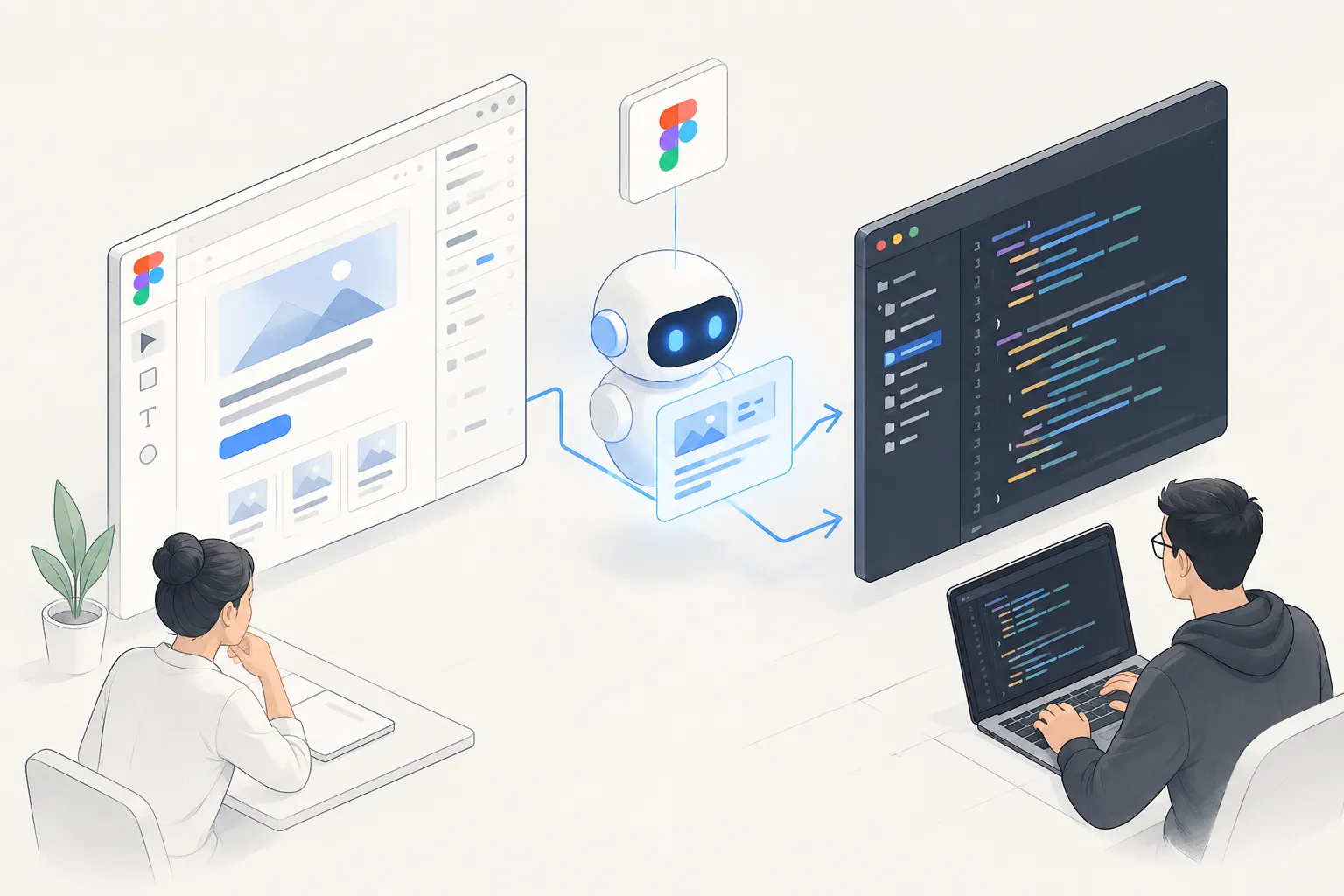
When a designer sends me a Figma link these days, I do something I didn't do two years ago: I let a machine read the file first. Figma has opened its designs to AI agents this year and added tooling like Code Connect and an MCP server, which can map a component in the design to a specific component in the codebase. This has produced a lot of excited headlines about the design-to-code gap being officially dead. I want to explain what actually changed — and what didn't change at all.
What the new tooling actually does
Simply put: I used to look at a Figma file with my eyes and retype values like spacing, colours and font sizes into code by hand. Now a tool can read the structure of the file directly — not just an image, but the fact that this element is a component called Button / primary / large, uses the colour token brand-500, and has 12/24 pixels of padding. If the project has Code Connect set up, the system also knows that this Figma component corresponds to a button that already exists in our codebase. So it doesn't invent a new one — it uses ours.
The difference is that AI stopped guessing from a picture and started reading data. Where a design has clean structure, the result is surprisingly good: a rough skeleton of a page appears in minutes instead of hours.
Where it breaks down
The catch is that the output is exactly as good as the structure of the design. The tool reads what you put in the file. If a button is drawn five times across five screens as a rectangle with text on it, the AI sees five different rectangles and produces five different buttons. If it's one component with variants, it sees one component.
The same goes for colour and spacing. A design where colours live as variables (tokens) translates into code almost by itself. A design with twelve greys picked by eye means someone has to ask whether two nearly identical hex codes are intentional or a typo. That someone is usually me, and it's the dullest part of my job.
The second catch: AI can't infer what isn't in the file. How does this behave while data loads? What happens when a user's name wraps onto three lines? What does the error message look like? Those states are often missing from designs, and no agent will guess them correctly.
What developers want from you now (and what they don't)
Good news for designers: the list of asks has actually got shorter. I no longer need icon exports in five sizes, or pixel measurements written out in comments — I can read those from the file myself. What I do want:
Components instead of copies. One component with variants, not fifteen separate groups. This is by far the biggest lever on project speed.
Colours and type as variables. Not values chosen individually for each element.
Named layers. Header / nav / link instead of Frame 247. It sounds like pedantry, but both humans and AI navigate a file by its names.
Extreme states. The longest possible text, an empty list, an error message, a loading state. A sketch is enough — it doesn't have to be polished.
What I no longer need is every screen size drawn out. Modern CSS handles a lot of layout on its own — a component can now adapt to the width of the space it sits in, not the width of the window. Mobile and desktop plus a sentence about what should happen in between is usually plenty.
What hasn't changed
What hasn't changed is that someone still has to understand the output. AI generates a skeleton, but decisions like this button has to be reachable by keyboard, this image will add a second to page load, or a screen reader can't make sense of this label are still made by a person. Handoff hasn't become a one-way pipe. It's become a faster conversation.
And I think that's good news. The time that used to go into retyping values from a design into code can now go into questions worth arguing about: whether that animation helps or just delays people, whether the form needs seven fields or would work with four. That's work a designer and a developer do better together than any agent does alone.