A book that treats a fiction as if it were a building site. I read it twice with a ruler in hand.
EH
Eva Horáková
Architect · ČVUT Praha
A unique fictional project that never existed.
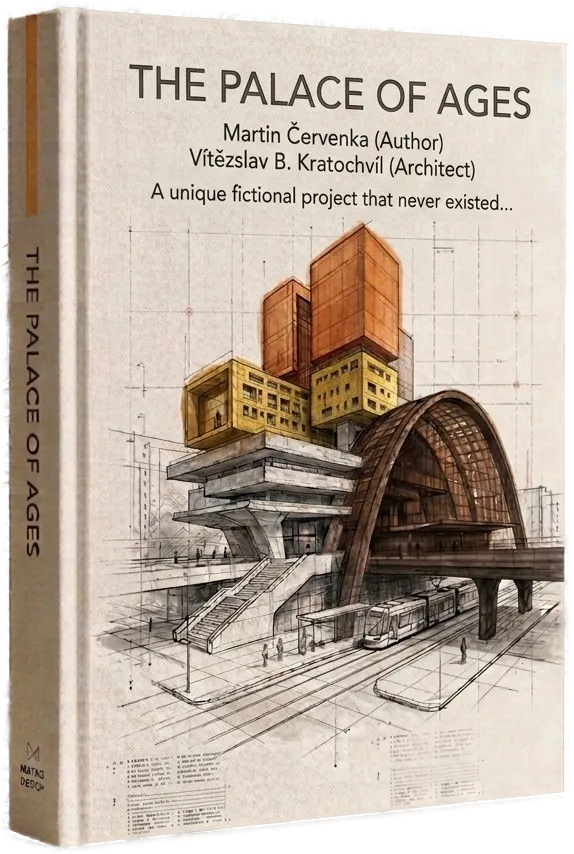
A 312-page architectural monograph documenting a building that lives only on paper — drafted joint by joint, façade by façade, as if it had been commissioned, approved, and completed. A study of construction as fiction, and fiction as construction.

A draftsman who built only on paper. For forty years Kratochvíl drew structures no city would commission — not because they could not be built, but because nobody dared to.
Trained in Brno, exiled to Prague, refused by three regimes — his archive of 4,000 drawings was discovered in 2019 in a stack of milk crates. What surfaced was a single obsessive project, drawn and re-drawn for half a lifetime: The Palace of Ages.
Three stacked masses balanced on a single concrete arch — a tramway threading beneath, a covered plaza above. Kratochvíl drew every joint, every shadow, every cubic meter of concrete as if construction began tomorrow.
The book reconstructs the entire dossier: orthographic plans, isometric studies, material specifications, weathering predictions across two centuries. It treats the unbuilt as if it were real. A monograph for a phantom.
Every spread treats the imaginary as evidence. Construction details with parts lists. Material samples. Site studies. A monograph that refuses to admit its subject doesn't exist.

First-edition reception from architects, historians, and the kind of reader who keeps a magnifying glass on the desk.
A book that treats a fiction as if it were a building site. I read it twice with a ruler in hand.
The most quietly radical monograph of the year. Kratochvíl built nothing — and built everything.
An archive that shouldn't exist about a building that doesn't. And yet here it is, on my shelf, weighing 1.6 kg.
Červenka has written architecture into being. The drawings are real. The building never will be. The book is necessary.
Three editions, all printed by Natag·Deop in Brno on uncoated paper specified by the architect. Shipping worldwide from May 2026.
The complete monograph, softbound, for everyday handling.
Linen hardback with foil-embossed spine. 500 numbered copies, signed by the author.
For studios and libraries. Includes a folio of 12 facsimile drawings ready to frame.
Architectural historian, essayist, and accidental archivist. Spent four years sorting Kratochvíl's milk-crate archive page by page.
Born in Olomouc, 1971. Author of three earlier books on Central European modernism. Writes for Era 21, A2, and the Czech edition of Domus. The Palace of Ages is his first work of architectural reconstruction — a form, he argues, that should be its own discipline.
